
Why does being queer come with a dress code?
In the fitting room with Santi, the T-boy using fashion as a queer self-discovery tool
 Published on November 24th, 2026
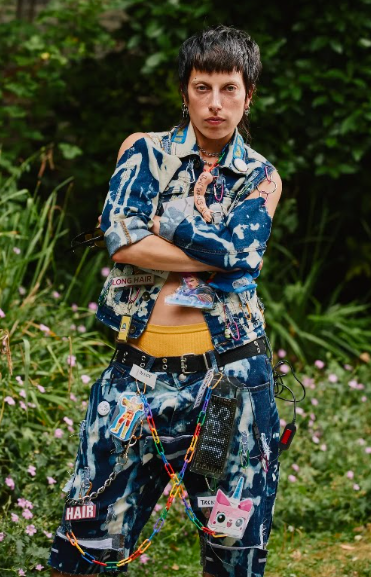
Clothing can be one of the most political tools we have: beyond decoration, it can be a powerful means of declaration.
Today I’m meeting Santi (they/he), a fruity trans masc femboy, as he likes to call himself. Santi is a queer creative and community organizer based between Berlin and the UK. They are the founder of Gender Swap, a UK-first trans style support initiative offering style workshops and resources to help trans and gender non-conforming people build their self-expression. They also founded T-Boy Sweat, a sauna experience exclusively for trans men and trans masculine people.
We sat down to talk about how style became a self-discovery tool for them, why gender transition isn’t linear and how they learned to flirt on Instagram.
@ceci.drf
Hi Santi, you’re the founder of GenderSwap, how did this fashion initiative start?
“I grew up in a very strict Catholic household where there was no room for self-expression. But my mum would sew most of my clothes, so I grew up understanding that clothing could be deeply personal.
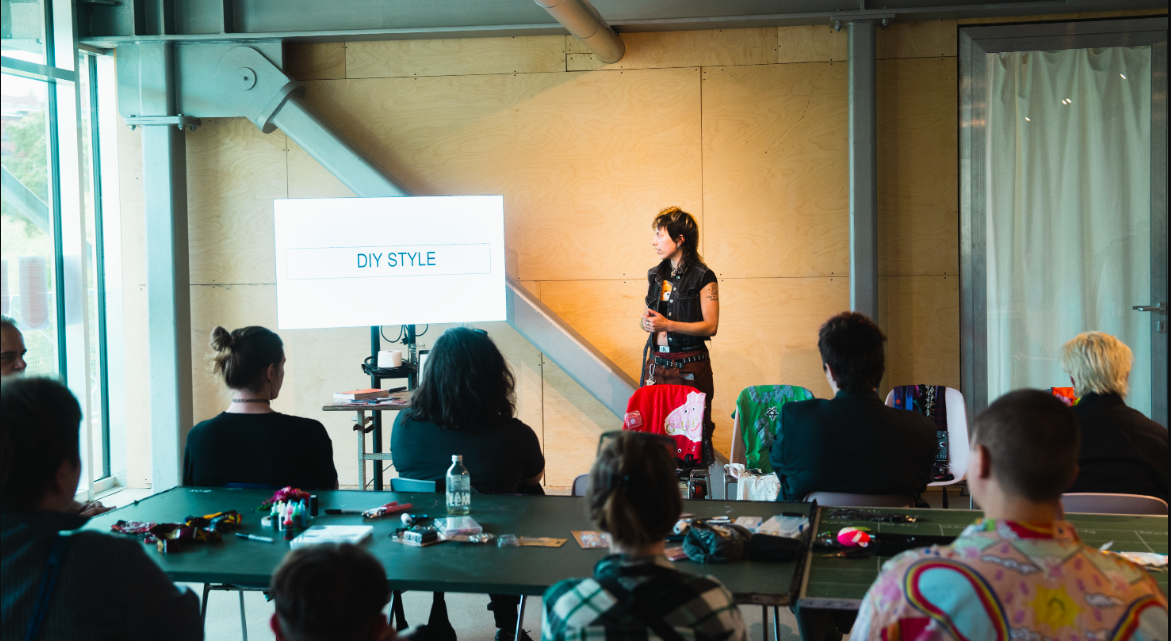
Later, when I came out and started wondering who do I want to become and how do I want to present myself, clothes appeared as an obvious medium. My friends introduced me to thrifting and DIY and it clicked. So I just decided I wanted to share my knowledge and resources with other people that could be helped by fashion too.”
@ceci.drf
Gender Swap started as a community clothing swap in 2017. But it was never just about the clothes. “I didn’t know who I was when I started Gender Swap, but clothes helped a lot. They helped me meet and connect with other queer people as much as they helped me find myself. So gradually Gender Swap concept moved from exchanging clothes to leveraging style as a way to help other trans people to find the right way to express themselves.”
What clothing did for you that other transition tools may not?
“My process of how I want to present has never been linear,” they say. “When I first came out as non-binary, I felt like it had to come with a script. Wear one earring. Cut my hair. Buttoned-up shirts. Stop wearing make-up.”
“But then I realized that I actually like my hair longer. I used to work as a make-up artist and I still wanted to wear make-up too. But there aren’t many resources outside the binary, so I was a bit lost.”
Santi’s answer touches something rarely discussed: the pressure to conform to a gender-normative script when transitioning. As if for a trans masc person, being taken seriously meant erasing every feminine element.
“At the beginning, I felt like I had to eliminate everything to be accepted and be seen in a certain way,” they say. “But then I realized: maybe I don’t want to conform. I just want to be. Be as Santi.”
Living between Berlin and London, do you feel like fashion is differently gendered across these two cities?
“It’s funny, but in Berlin I’m perceived right away as someone really masculine. In London, I’m perceived more fluid, more femboy,” they say. “In Berlin, I feel that there’s more specific coding, it’s more categorized while in London, I see a lot of binary trans guys wearing make-up.”
“To be honest, I don’t really care about other people’s perception. My question to myself is always: how can I make it more me? You can wear your baggy jeans and a top, but with patterns and stuff that would be completely different from what someone else would do. My motto is DIY. Always DIY.”
@ceci.drf
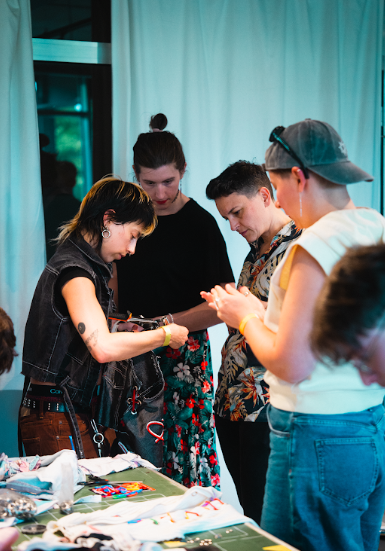
Santi practices what they call clothing surgery: transplanting fabrics, cutting, reassembling. Turning garments into something that couldn’t exist off a rack.
“In the same way your gender presentation doesn’t have to fit a box, your fashion presentation doesn’t have to either” they explain. “I want to show that I’m still confused about who I am. There’s a lot of pressure to completely change when you transition. But it’s not only about actualizing your gender: it’s about questioning the binary.”
There’s an interesting piece of Santi’s philosophy here: we talk a lot about medical transition: hormones, surgeries. But we talk much less about social transition: the way you cut your hair, pick your clothes, walk into a room. For Santi, it’s where a huge part of the work happens, and we don’t give it enough credit.
The inner journey: from labels to connection
I ask Santi about the inner journey behind style: figuring out what you want, versus what you’ve been told to want, versus what others expect. And whether that echoes in other parts of their life especially in dating or sexuality (my fav topics!).
“Labels have been really hard for me. For a long time I was stuck because of them. If I’m a T-boy and I date a lesbian, what does it say about me? What will other people think about me? I sometimes felt pressured to conform to what family and friends thought. But at the end of the day, I realized I just needed to focus on whether the connection was worth exploring or not.”
Santi’s identity shifted with their relationships. “I started a straight life. Then I identified as a lesbian because everyone told me I was one, even though my first relationship was with a trans masc non-binary partner. Through time, this identification started to feel awkward and I started to have dysphoria. So I labeled myself more fluid, queer. Now I label myself as a gay boy, even though I date whoever I have a connection with but this is how I feel. Inside, I identify as a queer boy, a bit fem.”
They laugh: “Boy dyke. Fag dyke. I like to play with words now. I’m less serious about labels.”
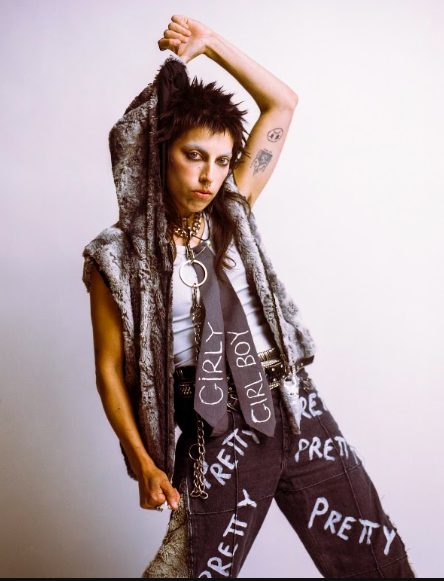
@Dyke Digital
Apps, aesthetics, and the golden ticket mentality
Since Santi has been navigating queer connection for years, I ask them what they think of the apps be it for dating, hookup or even friendship.
“I used to be a dating app addict,” they admit. “When I came out as queer, I was craving connections. I’d lived in so many places where there were no options. I had a golden ticket mentality, looking for the one online. I would delete the apps and get them again.”
But there’s a catch: “I found it really hard on apps because they’re too strict about what you’re supposed to look for and most of the time I didn’t really know what I was looking for. It depended on the person, on the chat. I was overthinking a lot on bios. I’m an overthinker, so it would take me forever to craft my profile.”
And then there’s the trans experience of the apps.
“People want to put you in boxes, there are a lot of fixed gender roles,” Santi says. “It’s also hard because I’m microdosing hormones, so I sometimes feel like I can’t be taken seriously as a trans person. Like I’m not man enough.”
Dating with dysphoria
I ask how dating actually works when there’s dysphoria in the mix.
“Casual hookups are harder on my side,” Santi says. “I need a certain amount of information about the person before engaging in anything intimate and I want the person to have information about me. But at the same time I want to keep things sexy so it’s harder to navigate.”
Their solution: lean into trans-only spaces. Their advice for anyone navigating this: “It’s your own formula about what your key triggers are. You can have a list of topics you want to chat about before you have sex, what areas you’re not comfortable with. It’s also about honoring yourself as being able to change your mind and go back home.”
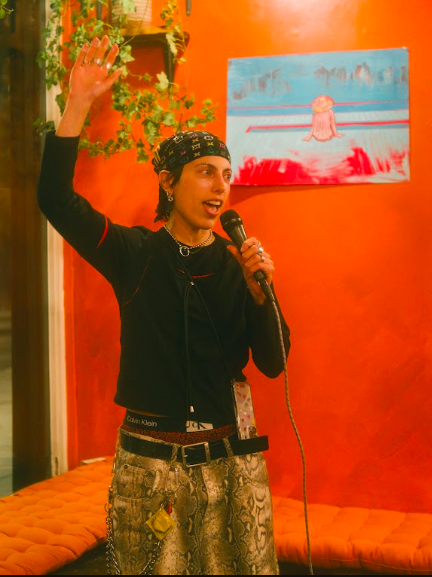
@aurali_sm
And have you been on Grindr?
“I used it when I wanted to have sex NOW, but it was overwhelming. I was scared to meet strangers because of safety issues but at the same time, the idea of doing it is so sexy. So sometimes I would just text online.”
Now, Santi dates from Instagram. “I feel like I know more about people there.” Here is the flirting-on-Instagram masterclass I received from Santi: “If you find someone cute, you follow them, you like 2-3 pictures, then you wait. Then after 2 or 3 weeks you like a few stories. Then you wait a bit, you react to stories, then you wait for them to react back. Then you comment on a story. And there you are, in the DMs, offer fast to meet for a drink.”
One last question cause we’re now in Berlin: What do you think of the word FLINTA?
(Quick reminder: FLINTA is a German acronym for Frauen, Lesben, Inter, Non-binary, Trans, Agender: an attempt to create spaces without cis men.)
Santi is honest: “I only heard about the FLINTA term when I moved to Berlin. I wonder how useful it really is. My reservation is that it doesn’t seem as diverse as it wants to be. It’s dominated by a certain type of people: people who present heavily feminine. I don’t feel there’s really a space for people who don’t. I don’t see a lot of transmasc representation in FLINTA things. For me, this term doesn’t value the genderfuckery that queer spaces could. AMAB 1 non-binary folks are missing. Binary trans guys too.”
“FLINTA spaces could be less young and less white too,” Santi adds. “I love underground dyke, trans, faggy places. But in Berlin, I feel there’s a lot of distinction between dyke spaces and gay spaces. And I’d love to have more conversation, more common spaces. It’s an ongoing issue.”
What Santi is building
Between Gender Swap and T-Boy Sweat, Santi is building the spaces they wanted to find. Where you can be a fruity trans masc femboy and no one asks you to pick one. If there’s one lesson from this conversation, it’s that the point of queerness isn’t to fit a shape, it’s to find your own.
Follow Santi on Instagram: @santibabi
Learn more on Gender Swap: @genderswap
And gather with other T-boys and Trans Masc people at the next T-Boy Sweat event, on December 3rd at Club Sauna (Berlin)
AMAB: Assigned Male At Birth. It’s a way of describing what sex someone was labelled at birth, without saying anything about who they are now.