
Grindr for queer women? Top Reddit question with no answer
On queer women and hook ups.
 Published on June 23rd, 2026
For those who haven’t read the previous pieces, this is part of a series on what came up over the last two months of conversations I had with queer women, trans and non-binary people about connection in a big city. This particular piece focuses on queer women, as it explores the stories, myths, and constraints that shape women’s desire in society. Trans men and non-binary people live their own versions of this.
In twelve years of being out as a queer woman, I’ve had this conversation countless times. How come there’s almost nowhere to hook up if you’re a queer woman?
I started googling. The same question is everywhere. Magazine articles, old forums, Instagram posts, reels, Reddit threads going back years. The question that kept coming up was “Grindr for us?” with a chorus of replies saying the same thing: there isn’t one, but we want one.
The simplest answer to why is: we don’t have much of a cruising culture, historically. But we have a hookup culture. Or we did. And we still want one.
What the survey showed.
When I asked respondents what frustrated them most about current apps, one of the most common complaints was the exact opposite of the cliché. “Not focused enough on hookups.”
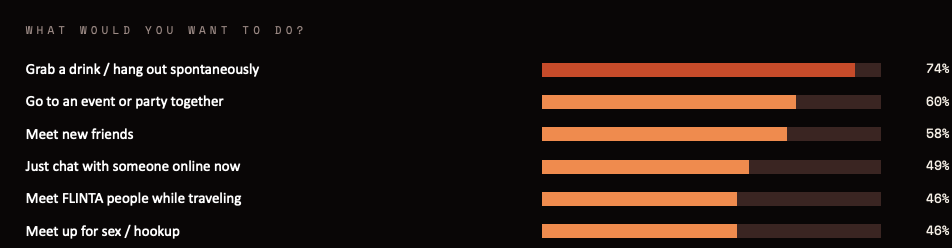
When I asked what they’d want to do on an app built around right-now availability, “meet up for sex” was high on the list, picked next to drinks, friends, and events. Not instead of them. Alongside.
The story we’ve been told about queer women is that we want depth, slow building, lesbian bed death or a U-Haul on the second date. We do want depth. We also want to come over for something physical, or have someone come over to us, on a random Tuesday. None of these desires cancel each other out.
“YES I’d love a FLINTA hookup app.”
The desire, with nowhere to go.
One of the people I interviewed, a regular in Berlin's cruising scene, told me: “I’m into hookups. There was a peak with dating apps a few years ago, but it’s not giving anymore. People don’t use them much anymore. And we don’t even talk to each other in bars now.”
She organises sex parties and goes to others, but none of it is spontaneous. It takes weeks of planning, group chats, vetting. The infrastructure exists in patches but depends entirely on knowing the right people.
Cruising isn't for everyone, of course. Most people I talked to described something else: listening to their own desire on a given night. Sleeping with someone they actually want to sleep with. Feeling fully alive in their body for an evening, without a calendar invite three weeks ahead.
I also talked with couples who want to explore their sexuality together. A third, a play space. None of them knew where to start, so the wanting stays inside the relationship.
The spaces we used to have.
In some cities, queer women used to have more places to act on their desire. What's left now is thinning.
- Berlin had cruising areas for queer women. They’re gone.
- Lesbian bars don’t exist in most big cities anymore.
- Sex parties for FLINTA do happen here and there, which is real, but they require being available on a specific date.
Can’t I just want a hookup in my bedroom on a random weekday?
And outside of the spaces made for us, you’ll have to guess who’s even queer before you can guess who’s down. When we’re not visible to each other, the scene feels small. The people are just hidden in plain sight.
So the desire is there. The conditions aren’t.
Why we don’t speak it out loud.
There’s another layer to this, which is what we do with the desire when it’s already there.
A lot of us refuse to sexualize each other. We know how that feels. We’ve been on the receiving end of it our whole lives, from cis men who took our bodies as theirs to look at, comment on, reach for. We don’t want to do that to someone else.
But refusing to objectify isn’t the same as refusing to be wanted when you want it, and left alone when you don’t. There’s a difference between projecting desire on someone who didn’t ask for it and meeting desire with desire when it’s mutual.
So we sit next to each other with all this desire and never speak about it out loud. We’ve internalized the idea that to be respectful, we have to mute ourselves.
Why this matters more than hooking up itself.
The reason all this is worth writing about isn’t that hookups are the goal. It’s that the right to seek them is part of what self-determination looks like.
Audre Lorde wrote that true liberation encompasses the freedom to choose: the absolute right to engage in, refrain from, or explore one’s sexuality on one’s own terms, free from shame, coercion, or judgment.
Queer women are raised inside the same scripts everyone else is. That women shouldn’t want sex. That wanting it makes you predatory, or pathetic, or shallow. That the right kind of woman wants love, not lust.
Hookups, when they’re hot, fun, safe, intentional and thoughtful, are also one of the spaces where queer people explore who they are. They affirm an identity. They reconnect us with our bodies after weeks of holding ourselves back. They let us define our desire on our own terms.
So.
The reason the “Grindr for queer women” threads keep coming back, decade after decade, isn’t that nobody noticed the gap. It’s that the people who could have built something for us didn’t think it was important enough.
Another reason is that Grindr, as a model, was never going to fit us. It does one thing well. We want many things, all at once, with full intensity. A drink and a hookup and a friend and a maybe-something-more. Not in sequence. In parallel. Sometimes on the same night.
So what we’re really asking for isn’t Grindr. It’s a space that lets all of those desires exist together, and lets us act on any of them, spontaneously, on any given day. Hot, fun, safe. Intentional and thoughtful. Without anyone telling us we should be wanting less.
Pulp is being built with that in mind. More soon.
Pulp is built with the people it’s for. If any of this resonated with you, I'd love to hear your thoughts.
Naomi